
5 Things I've Stopped Apologizing For
On language, ambition, power, and the art of taking up space

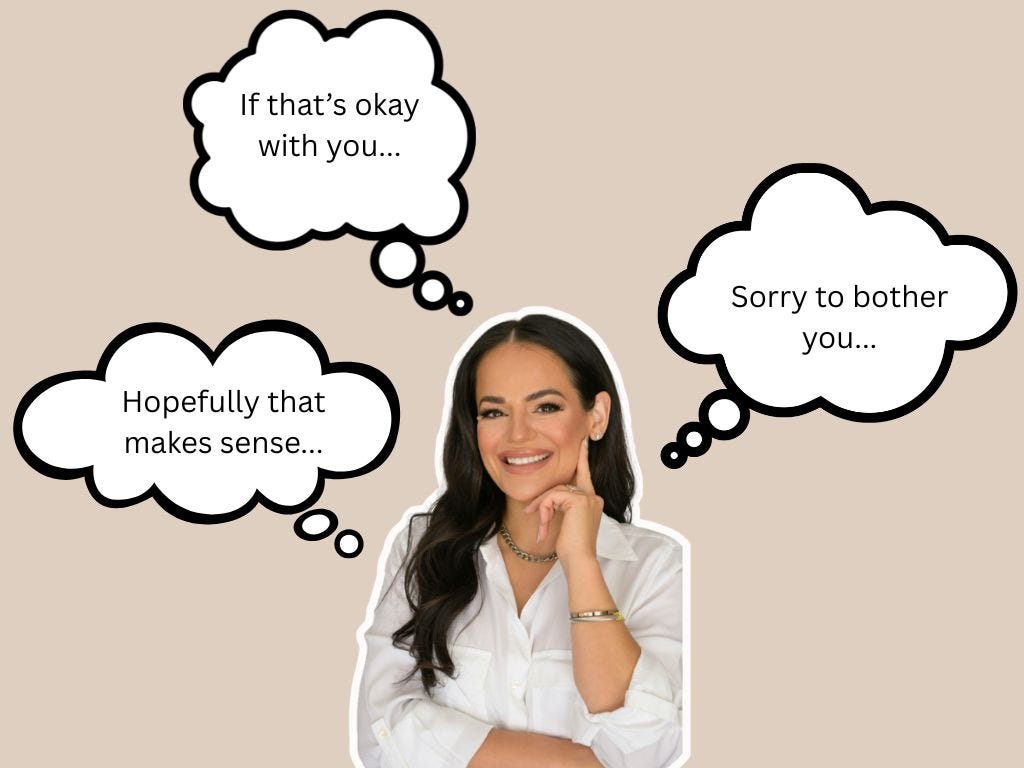
For years, I carried a linguistic toolkit designed entirely to make myself smaller.
I used to apologize for everything. Maybe it’s the Canadian in me. But it wasn’t just the word “sorry.” It was more than that. It was an entire architecture of phrases I used to soften my presence, dilute my authority, and preemptively protect other people from my ambition.
"Hopefully this makes sense..."
"If that's okay with you..."
"I just wanted to check if..."
"This might be a dumb question, but..."
I used these phrases like crutches. Every time I had a strong opinion, I wrapped it in a minimizer. Every time I set a boundary, I asked for permission first.
A landmark study published in Psychological Science found that women apologize significantly more than men, not because men are reluctant to admit wrongdoing, but because women have a much lower threshold for what we consider offensive. We perceive more situations as requiring an apology. We are socially conditioned to believe that our mere existence, our needs, our boundaries, our ambition, is an imposition on others.
In sociolinguistics, this is called "linguistic hedging." It's a power-surrender mechanism. Every unnecessary "sorry," every "just," every "hopefully this makes sense" is a micro-act of self-demotion. You are linguistically signaling to the other person: I am the one imposing.
As a minority immigrant woman climbing the corporate ladder, these phrases weren’t just a habit, they were a survival strategy. I learned early that taking up space without softening it first could get you punished.
I realized that the language was just the symptom. The real work was dismantling the beliefs underneath. Every time I said "hopefully this makes sense," what I was really saying was: “I hope you agree with me, I hope I didn't make you upset." Every time I said "if that's okay with you," what I was really saying was: “your comfort matters more than my needs.”
I decided to stop. I decided that an apology is a gift meant for moments when you’ve genuinely hurt someone or made a mistake. But when you apologize for existing, for having needs, for taking up space, for making choices that serve you, you’re not being kind. You’re being small.
Here are the five things I no longer apologize for. And if you’re still apologizing for them, this is your permission slip to stop.
1. Not being loyal to people who weren’t loyal to me
We treat loyalty like an absolute virtue. We romanticize the “ride or die” mentality. But loyalty without reciprocity is self-abandonment.
When you stay loyal to an employer who underpays you, a friend who drains you, or a partner who disrespects you, you aren’t demonstrating moral superiority. You are participating in your own exploitation.
Walking away from relationships that are one-sided or toxic, is one of the hardest things you'll ever do. But staying out of guilt isn't self-love, it's obligation.
I used to apologize for walking away from relationships where I had invested years of my life. I felt guilty for “giving up.”
I don’t anymore. I am fiercely loyal to the people who are loyal to me. But I've stopped apologizing for matching people's energy. If your loyalty to me is conditional, my presence in your life is temporary.
2. Changing my mind
We reward people for “staying the course” and punish them for evolving. If you change your mind publicly, you’re called a hypocrite. If you pivot your career, you’re called lost.
I change my mind based on new inputs all the time. I don’t live in absolutes.
Consistency is overrated. In psychology, the ability to update your beliefs when new information arrives is called cognitive flexibility and it’s one of the strongest predictors of psychological resilience. The people who never change their minds aren’t principled. They’re rigid. And rigidity breaks.
I used to apologize when I outgrew a belief, a strategy, or a version of myself. I would say, “I’m sorry, I know I said X last year, but...”
Now, I just say: “I’ve learned new information, and I’m adjusting my position.” Growth requires evolution. And evolution requires the courage to admit when something that once fit no longer does. I’m not sorry for becoming someone different than I was five years ago.
3. Not forgiving everyone
This is the one that makes people the most uncomfortable. We are deeply conditioned by forgiveness culture. We are told that forgiveness is “for you, not for them,” and that you have to forgive in order to heal.
And I agree with this to a certain extent, but it really depends on the situation and the person.
Recent research challenges the forgiveness mandate. A 2022 study found that when trauma survivors are pressured to forgive before they're ready, or when the offender hasn't taken accountability, forgiveness can actually be psychologically harmful.
I have worked in environments where bullying was normalized. Where people tore you down behind closed doors and smiled at you in meetings. Where toxicity was dressed up as "high standards" and cruelty was excused. According to the Workplace Bullying Institute, 32% of working Americans report being bullied at work, and 72% are aware of bullying happening around them.
I used to apologize for holding onto anger. I thought it meant I wasn’t “evolved” enough.
Now I know that sometimes, the healthiest thing you can do is set boundaries that keep you safe, emotionally, mentally, physically. You can heal, you can move forward, and you can find peace without allowing space in your life for the person who broke you.
4. Wanting power (not just “impact”)
Women are taught to want “purpose” because wanting power makes people uncomfortable. We have sanitized our ambition into acceptable, non-threatening language. We say, “I just want to make a difference,” or “I want to have an impact.”
What we need to start saying, unapologetically, is: “I want power.”
Power is the ability to make decisions. Power is the ability to allocate resources. Power is the ability to shape outcomes. Purpose without power is just hoping someone else will let you do the thing you want to do.
Power isn't domination. It's agency.
The data on this is infuriating. The latest Women in the Workplace report from McKinsey and Lean In revealed a growing "ambition gap", not because women don't want to lead, but because companies are rolling back support. And research on "Tall Poppy Syndrome" shows that almost 90% of ambitious women worldwide are penalized and undermined because of their achievements at work.
In Hollywood, this conditioning runs even deeper. There's an unspoken rule: you are lucky to be here. That gratitude expectation is a control mechanism. It keeps people compliant, underpaid, and afraid to advocate for themselves.
I used to apologize for my ambition. I used to shrink in rooms so I wouldn’t intimidate anyone.
Now? I want to build, I want to lead, and I want the power to change the systems I operate in. More women need to say this out loud.
5. Having ambition while being a mother
Maternal guilt is not a biological imperative. It is a manufactured social construct.
Maternal guilt stems from socially constructed norms, not nature. The guilt you feel when you travel for work, or when you miss a school event, or when you simply want to work because you love your career? That guilt was installed in you by a system that relies on women's unpaid labor to function.
A survey released just last week (May 4, 2026) by Forbes confirmed that early motherhood significantly penalizes lifetime earnings, while women continue to bear the crushing "mental load" of household management.
I spent too long trying to prove I could do it all without inconveniencing anyone. I apologized to my kids when I had to work, and I apologized to my team when I had to parent.
But the truth is, my ambition isn’t something to apologize for. It’s something to model. I want my daughter to see a mother who builds, who dreams, who refuses to shrink. I want her to know that she doesn’t have to choose between loving her family and loving her life’s work.
What I Know Now
Here’s what I know now that I wish I’d known ten years ago:
Every time you replace an apology with a declaration, you’re rewiring the power dynamic in real time.
“Sorry I’m late” becomes “Thank you for waiting.”
“Sorry, can I add something?” becomes “I want to add something.”
“Hopefully this makes sense” becomes “Here’s what you need to know.”
You are allowed to have boundaries.
You are allowed to change your mind.
You are allowed to withhold your forgiveness.
You are allowed to want power.
And you are allowed to want more.
No apology necessary.
What have you stopped apologizing for?
With Courage,
Maryam
P.S. Your feedback really matters to me. If you have a few minutes, I’d love your thoughts in this quick 5-question survey.
You’re not being kind. You’re being small.” so very true thankyou
A lot of women were handed a whole verbal toolkit for making ourselves smaller, softer, easier to absorb. Half the work is changing the boundary, and the other half is dropping the language that keeps apologizing for having one.